

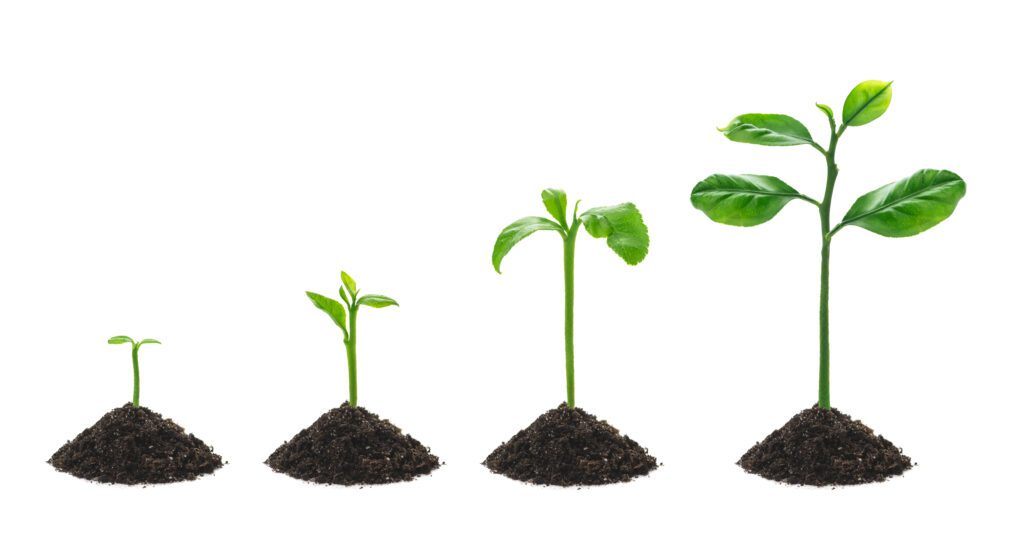
The life cycle of plants typically follows a series of stages that allow them to grow, reproduce, and start the cycle over again. While there are some differences between types of plants (like flowering vs. non-flowering), most go through the following basic steps:
🌱 1. Seed
- The life of most plants begins as a seed.
- A seed contains a tiny plant embryo and a food supply, protected by a seed coat.
- It remains dormant until the conditions (water, temperature, oxygen) are right for growth.
🌿 2. Germination
- When the seed absorbs water, it swes and breaks open.
- The embryo starts to grow roots (called the radicle) downward and a shoot (called the plumule) upward.
ll - This is when the plant first “wakes up” and begins growing.
🌱 3. Seedling
- A young plant, or seedling, begins to grow leaves and stems.
- It starts photosynthesis — making its own food using sunlight, water, and carbon dioxide.
- This stage is delicate and needs the right conditions to survive.
🌼 4. Mature Plant
- The plant grows larger and develops more leaves, stems, and roots.
- If it’s a flowering plant, it will produce flowers at maturity.
- This is when the plant is fully developed and can reproduce.
🌸 5. Reproduction
- Flowering plants reproduce by forming flowers, which contain male (stamen) and female (carpel) reproductive organs.
- Pollination happens when pollen is transferred from the stamen to the carpel (by wind, insects, animals, etc.).
- Once fertilization occurs, seeds begin to form.
🍎 6. Seed Dispersal
- The plant produces fruit or seed pods to protect and spread the seeds.
- Seeds are dispersed by wind, water, animals, or other means.
- Once dispersed, seeds can settle in the soil and the life cycle starts again.
Bonus: Non-Flowering Plants (like ferns and mosses)
- These reproduce via spores, not seeds.
- The life cycle includes alternation of generations between a spore-producing phase and a gamete-producing phase.
Have questions about plants? Our experts at Kiefer Landscaping can help!